
Eggs before chickens

I’ve sat through enough B2B strategy sessions to know exactly when the wheels start to come off. It usually happens about an hour into the first workshop.
You’ve brought together a room full of experts: IT directors, marketing heads, and operational leads. Before you’ve even defined what success looks like, someone starts talking about the checkout select box or the colour of the “Add to Basket” button.
This is the “Shiny Object” trap. It is the natural human instinct to solve easy problems with tangible features before we’ve addressed the difficult reality of the business need.
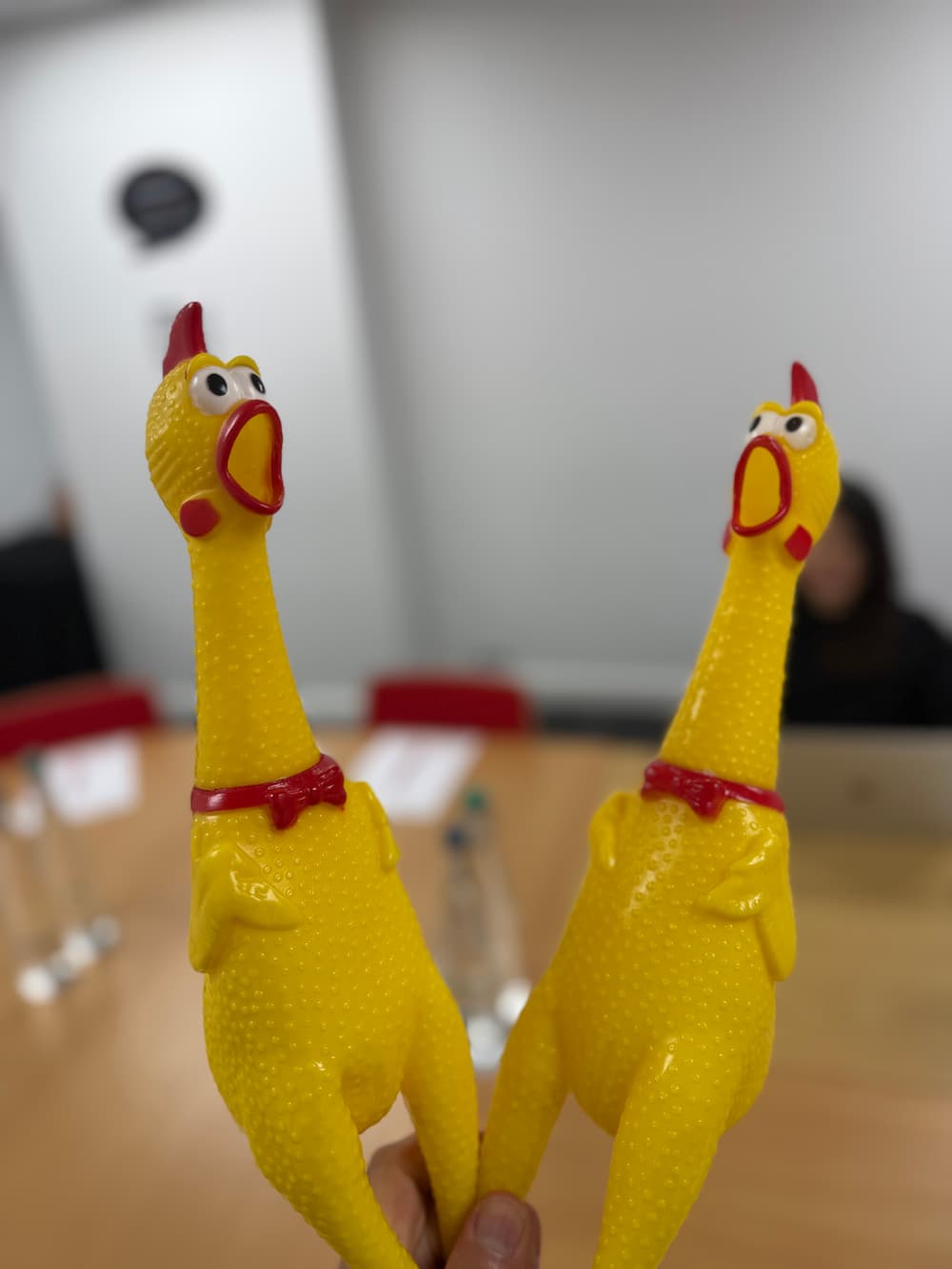
At Rixxo, we have a specific tool to stop this. It’s a squawking rubber chicken.
If we’re in a room and the conversation shifts from “Why are we doing this?” to “How does this specific feature work?”, the chicken squawks.
It’s a loud, annoying, and highly effective boundary. It signals that we are off-track. We are talking about solutions before we have understood the needs.
We call this “Eggs Before Chickens.”
If you start with the chicken (the solution), you’ll never get the egg (the vision). But if you nurture the egg first, the chickens will take care of themselves.
Feature discussions are the quickest way to derail a B2B project
Digital initiatives frequently fail because teams are not on the same page. A Gartner survey from 2024 revealed that only 48% of digital initiatives meet or exceed their business outcome targets. That is a staggering statistic. Over half of these projects, representing millions of pounds in investment, are missing the mark.
The reason is simple: teams are racing toward features.
In B2B commerce, the customer experience is rarely a straight line. You have complex pricing models, tiered approvals, legacy ERP integrations, and unique logistics requirements. If you start the project by listing features, you are building a house by picking the curtains before you’ve poured the foundation.
Team unity is far more critical than feature discussions. When experts from various disciplines, including marketing, operations, IT, and sales, have to contribute to a single success, they must first agree on what that success looks like. Without that agreement, you end up with “siloed success”. The developer builds a feature the marketer can’t sell, or the operation lead receives a system that doesn’t fit their warehouse workflow. In my experience, this is where implementations stumble repeatedly, usually three months in when the budget is already half-spent.
The squawking chicken is there to protect that shared agreement. It forces us to stay in the uncomfortable space of “Why” until the “What” becomes obvious.
You should onboard your partner like a senior hire, not a vendor
I see B2B leaders make the mistake of treating their agency or consultancy like a vending machine. You put in your requirements, press a button, and expect a platform to drop out the bottom.
That isn’t how high-performing B2B partnerships work.
I often use an “Indeed” metaphor. If you were looking to scale your business, you might put an advert on Indeed for a Head of E-commerce or a CTO. You’d look for someone with experience in your industry, someone who understands your team, and someone who has solved similar problems before. I’ve seen this go sideways three times this year alone because the hiring process focused on the tool rather than the person.
When that person joins your business, you don’t hand them a list of 500 requirements on their first morning. You onboard them. You tell them about the vision, the history of the company, and the “war stories” of where things have gone sideways.
Only after they are fully onboarded do you ask them to build the plan.
Engaging a partner for a project, a platform selection, or an integration should follow the exact same logic. You are hiring experience. You are hiring a team that becomes part of your team.
If you are still weighing up your options, this guide on how to choose a B2B eCommerce partner will help you avoid the usual mistakes.
The Rixxo Foundations™ process is our structured approach to that onboarding. It is how we learn about your vision, the “Epic”, so that when we start the project, we are asking questions as if we already understand the business.
We speak from experience, not theory, and that experience requires context.
The hierarchy of truth: Epic, need, requirement, then feature
To keep a project on track, you need a shared vocabulary. One of the reasons meetings descend into chaos is that “Requirement” means different things to different people. I sat next to the head of e-commerce for a £3 billion business recently, and they were asking exactly the same questions as a £500,000 business because they lacked this hierarchy.
We use a hierarchy to untangle this:
- The Epic: This is the destination. It is the high-level vision of what we are trying to achieve. For example: “We need to grow our trade business by 20% by enabling self-service for our existing wholesalers.” It is the linchpin of the entire project.
- The Need: These are the business problems that must be solved to reach the Epic. A need might be: “Our trade customers currently have to call us for every price check, which slows down their ordering process.”
- The Requirement: This is the logic that addresses the need. “The platform must display customer-specific contract pricing after they log in.”
- The Feature: This is the specific tool or piece of code that delivers the requirement. “A pricing API call to the ERP.”
The squawking chicken comes out the moment someone skips from the Epic straight to the Feature.
If you spend all day talking about APIs (Features) but haven’t agreed that the goal is self-service for wholesalers (The Epic), you are just spending money on code that might not solve the problem. Details emerge over time, but the Epic must be locked in early.
The “Team First” principle: Why experts must agree on success
In B2B, you are rarely just building a website. You are integrating a complex ecosystem of people, processes, and platforms.
You might have a logistics expert who knows everything about pallet shipping, an IT lead who knows the ERP inside out, and a marketing manager who understands the customer base. These are all specialists. I’ve sat with a $3 billion electrical wholesaler with 125+ outlets and seen the exact same silo issues that a small distributor circa £5m here in Bristol faces.
The danger in B2B is “siloed success.” The IT lead builds a technically perfect CRM integration that does enable the flows of the marketing team. The logistics expert sets up shipping rules that the platform can’t communicate to the customer at checkout. I’ve even had war stories from customers who have built incredible integrations across multiple platforms that work end to end. But the second that an order needs editing, because this is real life, the whole thing is rendered useless. The team are back to avoiding the new digital system because it causes unfamiliar problems.
Unity as a team is the only way to prevent this.
During our Foundations process, by eliminating conversations about features during these early phases, we force these experts to talk to each other about the business outcome. We find the “red flags” early. I’ve observed this hunger for needs-driven advice across the industry, particularly at events like Savant B2B, where businesses are rejecting feature-pushing in favour of operational stability.
We’ve had customers change the way they do their accounting, measure profitability, purchase ordering, team shape and sizes, and leadership all because of these foundations questions.
And that leads us on to this…
Ethical consulting means knowing when to stop the sale
Sometimes, during Foundations, we realise that a project shouldn’t go ahead.
Maybe the business need isn’t strong enough. Maybe the technical debt is too high. In traditional sales, a salesperson might push the deal through anyway just to hit their target.
But as consultants, we have a responsibility to the Epic.
I’ve seen this go sideways when agencies do too much “pseudo-consulting” before the contract is signed. They ask questions, draw diagrams, and get the client way further along than their ability allows, for free. It is only enough to get the deal across the line. Once across the line, this pseudo-consulting is taken as the groundwork and the project commences. Along the way, details emerge, but the team are not getting on the same page. The initial plan was not complete enough and the cracks begin to show.
Readiness is an investment. It is the work of making sure the project is viable. Whether building something, heading into platform selection, or even consulting as a team, we must be ready to do the work that is ahead. This in itself might be the ultimate egg before the chicken.
Moving from onboarding to high-performance delivery
Once Rixxo Foundations is complete, a project may begin. But it begins from a place of strength.
We aren’t strangers anymore. We are a team that has sat in a room, heard the squawk of a rubber chicken, and agreed on a single Epic. We know the “why” behind every decision that will follow.
In B2B commerce, speed is often cited as the goal. “We need to get to market fast.” But speed without unity is just a fast way to run in the wrong direction.
Foundations gives us the rhythm. It gives us the discipline to put the eggs before the chickens. It ensures that when we finally do start talking about features, those features are actually solving the problems that matter to your business.
Every digital transformation requires someone in the room who is brave enough to squawk when the conversation shifts to the shiny objects.
