
What does a platform selection consultant do?
Your eCommerce platform is your business engine. It drives every connection: sales performance, customer experience, internal efficiency, and integrations across your tech stack, ERP, CRM, and finance.
As your growth accelerates, that engine may begin to sputter. New requirements expose its limits, turning a familiar tool into a source of friction.
Migrating to a new platform is a strategic pivot that defines your operational model for years to come. It’s a financial, operational, and organisational commitment.
This decision demands structure and clarity. A platform selection consultant provides that.
When businesses need a consultant
Businesses often bring in a consultant when they have momentum for change but lack a clear way forward.
Internal teams get stuck in debate or overwhelmed by options. The stakes are high, with little room for error. Budgets and goals misalign. Every decision affects another, and misalignment surfaces quickly.
A consultant leads the process, challenges assumptions, and introduces clarity.
What a platform selection consultant actually does
A platform selection consultant supports one of the most commercially important decisions a business will make: choosing the right B2B eCommerce platform.
Their responsibility isn’t to follow trends or push particular platforms. They help the business understand how it really operates and guide a structured, objective decision.
They bring focus, experience, and independence. Their value lies in aligning stakeholders, creating clarity, and ensuring decisions are based on business needs rather than vendor influence.
Starting with the right question
Projects often begin with a search for “the best” platform. A good consultant flips that thinking.
First, define what “best” means for your business. What you need to achieve. What problems must be solved. What success looks like.
This prevents assumptions from undermining the outcome and keeps teams focused on solving business problems, not just buying tools.
The core activities
A platform selection consultant typically works through several activities:
Uncovering and validating business requirements
This goes beyond feature lists. It’s about understanding your business processes, integration needs, and operational realities. The consultant helps you document what the platform must support and why it matters.
Running workshops to align teams
Stakeholder alignment is where projects succeed or fail. Consultants facilitate workshops that bring sales, operations, IT, and leadership together. They surface conflicts early and ensure shared understanding.
Building structured criteria for evaluating platforms
Instead of vague preferences, consultants create objective scoring systems. They help you define what “satisfied” means for each requirement and how to measure vendor responses against it.
Documenting findings and leading vendor conversations
Clear documentation keeps everyone aligned. Consultants manage the vendor engagement process, asking the right questions and cutting through sales pitches to understand genuine capability.
Scoring options based on real business value
Not all features matter equally. Consultants help you weight requirements based on business impact, ensuring the final decision reflects what actually drives value for your operation.
Working with your team, not around them
A good consultant works with your team, not around them. They listen, challenge, guide, and bring frameworks that support faster, clearer decisions.
They remain involved beyond selection in some cases, providing strategic oversight during implementation to ensure the decision translates into reality.
The SPINAPE™ framework: bringing structure to platform selection
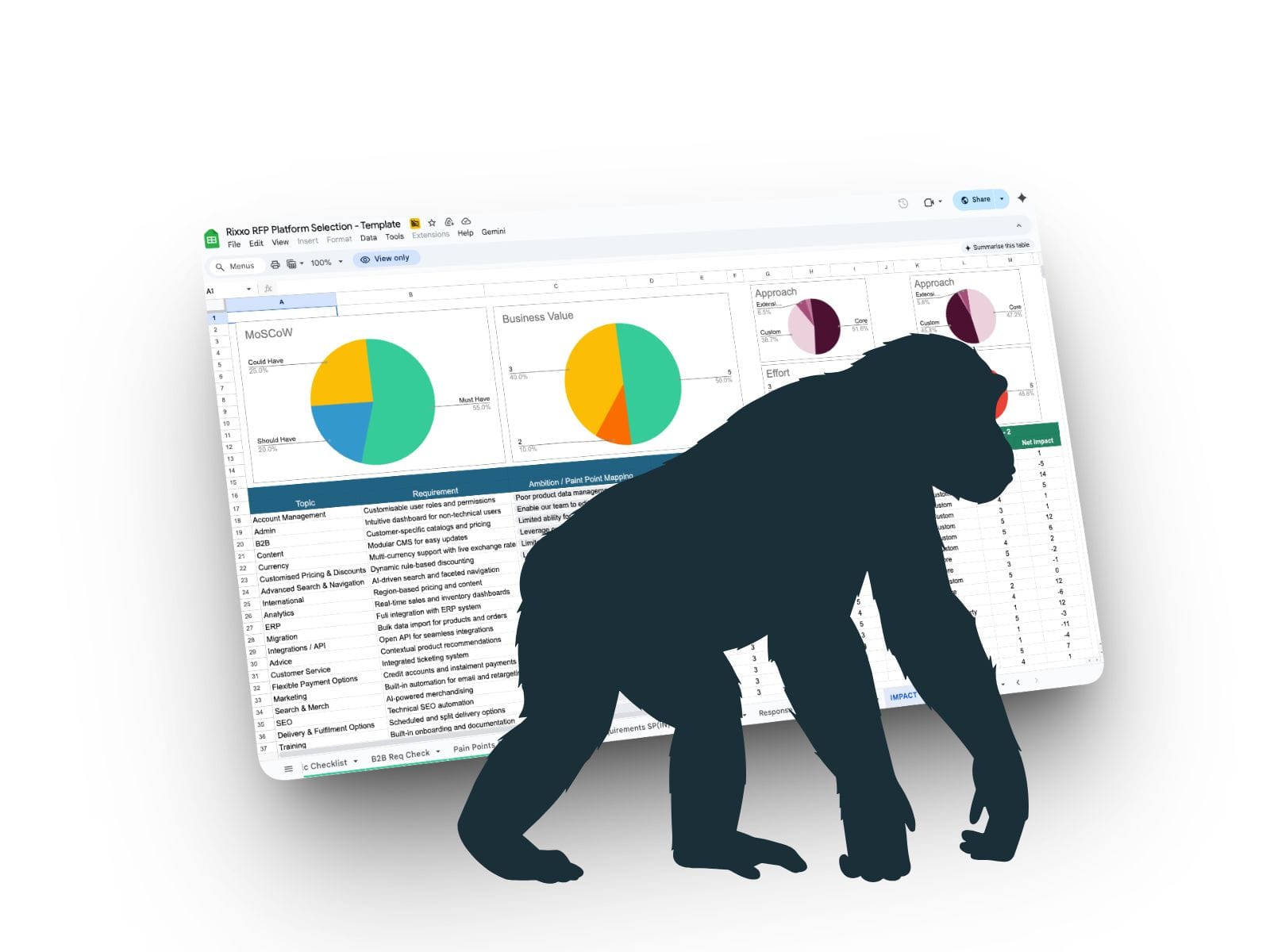
One structured approach is Rixxo’s SPINAPE™ framework, which introduces order and logic to platform selection.
Situation – What is happening in the business
Understanding the current state. Where the business is today, what’s working, and what’s creating friction.
Problem – What is getting in the way
Identifying the specific issues that need solving. Not symptoms, but root causes that prevent progress.
Implication – What happens if it isn’t fixed
Making the consequences clear. What breaks if nothing changes. What opportunities get missed.
Need – What needs to change
Defining the required capabilities. What the platform must support to solve the problems identified.
Align – Ensure the team agrees on direction
Creating stakeholder consensus. Getting everyone working toward the same outcome with shared understanding.
Propose – Invite vendors to map their tools to your needs
Structured vendor engagement. Asking vendors to demonstrate how they meet your specific requirements, not their standard pitch.
Evaluate – Score options based on impact and confidence
Objective assessment. Measuring vendor responses against your criteria and weighing them by business value.
This framework keeps teams focused on solving business problems. It ensures vendors respond to your actual needs rather than delivering generic demonstrations.
The platform selection process in practice
A strategic platform decision follows a clear, structured process.
Discovery: define the “why” before the “what”
Before evaluating platforms, clarify your goals.
This includes understanding commercial priorities and ROI expectations. Mapping current workflows and identifying where they break. Identifying blockers and risks that prevent progress. Aligning stakeholders on what success looks like.
As covered in Mastering B2B eCommerce Platform Selection, understanding your needs is more important than focusing on platform features. Platforms have converged in functionality. Your business has unique complexities that no platform will perfectly match out of the box.
This stage anchors the entire project. Without it, you’re comparing platforms against an unclear benchmark.
Requirements: build documentation that holds up
Once goals are defined, document what the platform must support.
Go beyond features. Capture business capabilities, integration needs, and governance requirements. Outline the budget and timelines. Define what “satisfied” means for each requirement.
Consultants bring frameworks that speed this up and improve accuracy. Better documentation leads to better vendor responses and a smoother process.
The requirements phase is where you translate business needs into clear, actionable specifications. Replace vague language like “should” with “must” and “will”. Define measurable outcomes for each requirement.
For example, instead of “the platform should be scalable,” specify “the platform must support a 50% increase in traffic year-over-year and handle peak periods with no downtime.”
Vendor engagement: run a structured process
With clear requirements, you can assess who can deliver.
Consultants manage shortlisting, RFPs, demos, and scoring. They know how to identify vague promises, glossed-over gaps, and distractions that create expensive issues later.
The vendor engagement phase separates genuine capability from sales performance. A good consultant asks specific questions tied to your documented requirements. They request proof of claims and push vendors to demonstrate, not just describe.
This is where independence matters. Consultants aren’t influenced by vendor relationships or commission structures. They evaluate responses objectively against your criteria.
Final recommendation: clarity backed by evidence
You receive a decision pack that includes a ranked shortlist, scoring breakdowns, documented rationale, and insights into risks and trade-offs.
You gain evidence and confidence in equal measure. The recommendation shows you how each platform maps to your requirements, where gaps exist, and what compromises you’d be making.
This documentation serves beyond the selection phase. It becomes the foundation for implementation planning and vendor accountability.
Why businesses choose not to use consultants
Some businesses attempt platform selection internally. This works when certain conditions exist.
You have deep platform expertise in-house. Your team has time to dedicate to the process without compromising daily operations. Stakeholder alignment already exists. The decision criteria are straightforward with limited integration complexity.
Without these conditions, internal selection often extends timelines and increases risk. Teams get caught in feature comparison without clear evaluation criteria. Vendor influence shapes decisions. Stakeholder conflicts go unresolved.
The cost of getting it wrong exceeds the investment in getting it right.
A poor platform decision compounds over time.
Operational friction
When the platform doesn’t match your workflows, workarounds multiply. Manual processes fill gaps. Staff frustration increases. Efficiency drops.
Integration failures
Platforms that can’t integrate cleanly with your ERP, CRM, or finance systems create data discrepancies. Trust breaks down between systems. Reconciliation becomes a constant task.
Customisation debt
Heavy customisation to force-fit a platform creates technical debt. Every platform update becomes a project. Maintenance costs escalate. You become locked into an expensive, fragile system.
Re-platforming costs
The most expensive outcome is re-platforming within two to three years. You pay twice for implementation, lose momentum, and damage stakeholder confidence in technology decisions.
These costs far exceed consultant fees. A structured selection process prevents them.
How consultant independence differs from vendor-led selection
Vendors have an inherent conflict of interest. They’re incentivised to sell their platform regardless of fit.
A consultant has no platform to sell. Their reputation depends on helping you make the right decision, not any decision.
This independence shows up in several ways:
- Objective evaluation
- Consultants score all platforms against the same criteria. They don’t favour options based on commercial relationships.
Challenge without agenda
When vendors make claims, consultants test them. They ask for proof, request demonstrations of specific capabilities, and identify gaps.
Long-term thinking
Vendors focus on closing the sale. Consultants focus on long-term fit. They consider your three-year roadmap, not just immediate needs.
Stakeholder advocacy
Consultants represent your interests in vendor conversations. They ensure your requirements drive the discussion, not vendor sales strategies.
This independence is what you’re paying for. It’s the difference between being sold a platform and choosing one.
A decision built on strategy
Choosing a new eCommerce platform is one of the most important business decisions you’ll make. It impacts revenue, operations, and customer trust for years to come.
The process is complex. Internal misalignment and vendor noise can turn it into a guessing game.
A platform selection consultant brings clarity. They don’t push software based on a feature list. They lead a rigorous process to secure a platform that aligns with your real business goals and growth plans.
With the proper process and guidance, your platform decision becomes a strategic advantage, one that shapes everything that comes next.
Ready to make your platform decision with confidence?
If you’re navigating change and need a structured, objective approach to choosing the right technology, we can help.
Get in touch to talk through your goals and see if our platform selection service is the right fit.
